

For years, property marketing has had a clear priority: presenting homes in the most attractive way possible.
Professional photography, perfect lighting and small digital edits have always been common tools to improve the presentation of a property and capture a buyer’s attention.
However, something is starting to change.
The massive arrival of generative artificial intelligence has created an interesting phenomenon. We are seeing more and more perfect images online, yet at the same time many users are beginning to distrust them.
And in the property sector, this can have important consequences.

When everything looks perfect, users stop believing it
Recently, the CEO of Instagram spoke about how the excessive amount of AI-generated content is changing user perception.
His reflection was clear: when perfect images become easy and cheap to produce, they stop being interesting. Users start to value content that feels real much more.
In other words: when everything looks too perfect, people start to suspect it is not real.
And in the property world, this can be particularly delicate.
Buying a home is not an impulsive decision like buying clothes or an accessory online. It is a significant emotional and financial investment.
If the buyer feels that the images they see do not represent reality… trust disappears.
The line between improving an image and altering reality
Artificial intelligence can be a useful tool in property marketing.
For example, to:
-
Improve the lighting of a photograph
-
Correct small visual imperfections
-
Create a decorative inspiration version
-
Show how a room could look furnished
In these cases, AI works as a visual support tool.
The problem appears when a line is crossed: when the image stops representing the real property and starts becoming an idealised version that does not exist. And that is when marketing begins to work against the seller.
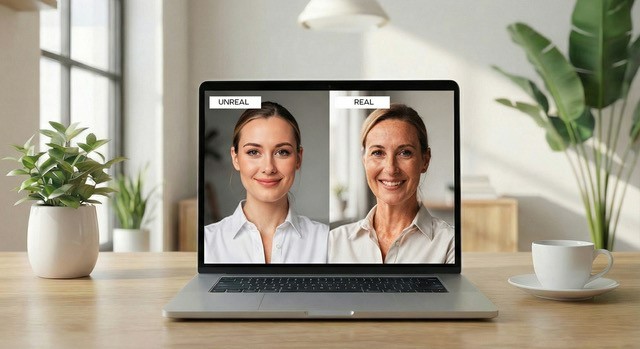
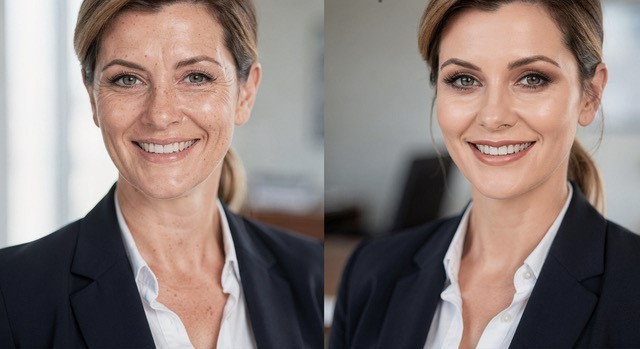
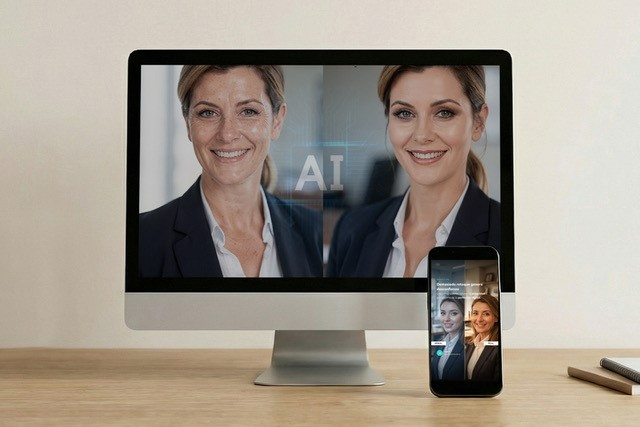
The same happens with corporate photos. A professional portrait of the team conveys closeness and trust. But when retouching becomes too extreme and the person no longer looks like themselves, the effect can be the opposite.
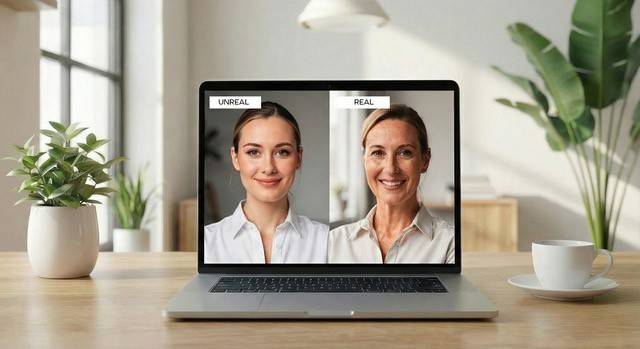
The commercial risk of unrealistic images
When a buyer sees a property online and later visits it in person, they expect to find something consistent with what they saw on the internet.
If the difference is too large, several things can happen:
-
It creates immediate frustration
-
The buyer loses trust in the agency
-
It creates a perception of lack of transparency
-
The property loses credibility
And most importantly: that visit will probably not end in an offer.
This is why many professionals in the sector agree that exaggerating or excessively altering the visual presentation of a property is short-term gain with long-term loss.
The new trend: returning to what is real
Interestingly, the more AI-generated content appears online, the more value people begin to place on authenticity.
Real images.
Natural videos.
Small details that show the property is genuine.
Some digital marketing experts are even beginning to point out that photos with small imperfections or a more natural style generate more trust than heavily edited ones.
Because they convey something extremely important: credibility.

The buyer wants to see the property, not an imagined version
Today’s buyer does a lot of research before contacting an estate agency.
They analyse property portals, compare homes, examine photographs carefully and increasingly consume videos or virtual tours.
If they feel that the images look unrealistic or excessively manipulated, it is very likely they will simply move on to the next property.
That is why more and more agencies are opting for a more balanced approach.
Professional photography, yes.
Moderate editing, also.
But always maintaining a faithful representation of the property.
It is not about presenting a property carelessly. It is about presenting it honestly.
AI as a tool, not a replacement for reality
Artificial intelligence will continue to evolve and remain part of property marketing. That is inevitable.
But its role should be to complement the presentation of a property, not replace it.
Used wisely, it can help to:
-
Improve visual quality
-
Explain renovation possibilities
-
Inspire the buyer
Used without control, it can produce exactly the opposite effect: distrust.
And in a sector where trust is essential to closing a deal, that is a risk worth avoiding.
In real estate, trust remains the most valuable asset
At a time when the internet is full of artificial content, agencies that choose a more honest visual communication will likely have an advantage.
Because in the end, buyers are not looking for a perfect image.
They are looking for a real home where they can imagine their life.
Image gallery